Living Lab | Week 5: Clearing the Clutter, Planting with a Purpose
Miranda Carter
Week of April 20 - 26, 2026 | Photos April 29, 2026
Week 5 was all about doing the unglamorous work that makes everything else possible. There were no dramatic reveals this week — just a lot of tilling, hauling, rearranging, and planting, the kind of slow, methodical progress that doesn’t photograph well in the moment but sets the stage for everything that comes next. If you’ve been following this journey, you know the Living Lab backyard is my working proof of concept — a space I’m transforming season by season into a living showcase for sustainable outdoor living, and eventually the future home of the Green Luxe Pods Capsule MVP.
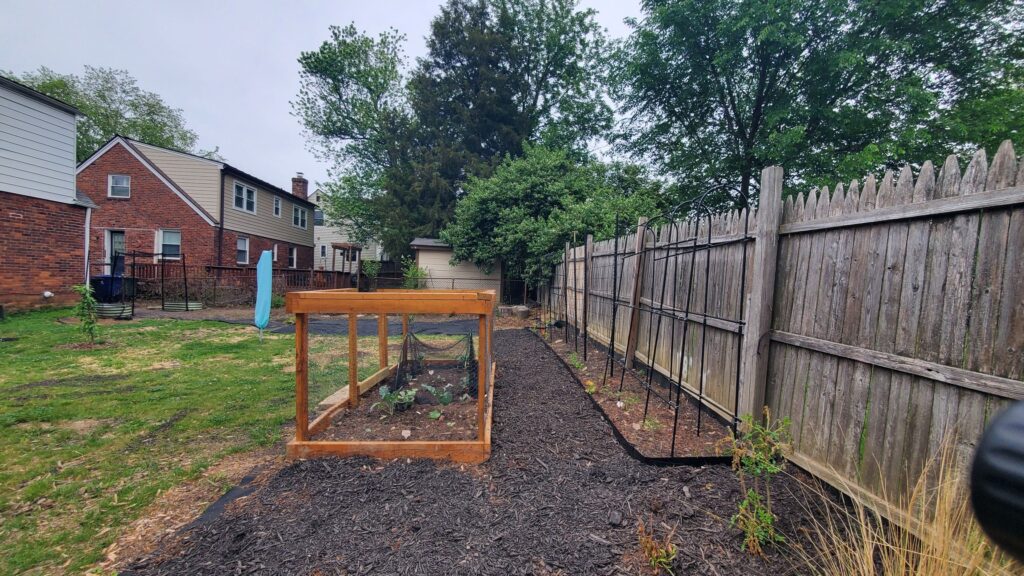
Fresh black mulch in the left foreground with the full yard visible behind — trellis frame, enclosure area, and fresh black mulch beds taking shape
Refreshing the Ground Layer
One of the simplest visual upgrades I made this week was switching from brown mulch to black for the top dressing. I didn’t pull up all the existing mulch — that would’ve been both expensive and wasteful — but a fresh layer of black on top made a noticeable difference in how cohesive the beds look. Dark mulch does more than just look polished: it absorbs heat, helps retain soil moisture, and suppresses weeds more effectively than lighter-colored alternatives. It’s a small investment with real practical return.
While I was reworking the ground layer, I also rearranged the native flower plantings along the side and left yard into proper clusters and groupings. Native plants tend to establish better and support pollinators more effectively when planted in masses rather than scattered individually, so this wasn’t just an aesthetic choice — it’s the right way to grow them. Getting them into intentional groupings now means they’ll have a stronger season ahead.
Pallet staging area — wood rounds, straw bales, pea gravel, old tarp, and garden supplies waiting to be sorted, reused, or disposed
Clearing, Staging and Reusing
I’ve been meaning to deal with the scattered extras for weeks — wood rounds, rock pieces, stray timber — and this week I finally moved everything not in active use to a dedicated pallet staging area. Nothing got thrown out. The goal is to sort through it and find a use or a new home for each piece. The bricks from the side yard came out too: I pulled them all, staged them on a pallet, and tilled and weeded that area so it’s ready for what comes next. Repurposing and reusing materials before disposal is a core principle of how I want Green Luxe Pods to operate, and practicing that here in the Living Lab keeps it real for me.
One of my favorite small wins this week: a concrete splash block that was just sitting around became the entrance pad to the enclosure. Repurposed, functional, and completely in keeping with the aesthetic. That’s the kind of resourceful problem-solving I love.
Side yard after bricks were removed — freshly tilled and mulched with fern groupings and plant starts along the chain-link fence
Preparing the Capsule Area
This was one of the most meaningful steps of the week, even though the photos don’t look like much yet. I installed black heavy-duty landscape fabric across the Capsule area and its entrance. The Capsule — an 8’ x 16’ high-performance modular office pod — is the MVP for Green Luxe Pods, and this is its future footprint.
The fabric is a practical prep measure: it suppresses weeds, helps define the boundary of the space, and signals that this area is transitioning from “backyard” to “build site.” Seeing that clean, delineated space for the first time made the whole project feel more real. We’re no longer just planning — we’re preparing ground.
Wide yard overview showing raised beds on the left, trellis frame on the right, and the Capsule area with black landscape fabric in the center background
This was one of the most meaningful steps of the week, even though the photos don’t look like much yet. I installed black heavy-duty landscape fabric across the Capsule area and its entrance. The Capsule — an 8’ x 16’ high-performance modular office pod — is the MVP for Green Luxe Pods, and this is its future footprint.
The fabric is a practical prep measure: it suppresses weeds, helps define the boundary of the space, and signals that this area is transitioning from “backyard” to “build site.” Seeing that clean, delineated space for the first time made the whole project feel more real. We’re no longer just planning — we’re preparing ground.
Wide view of the Capsule area with black landscape fabric laid out, backyard and house in the background
Planting Season in Full Swing
Looking through the garden trellis arch toward the cleared backyard beyond — raised metal beds on both sides, black fabric path leading to the Capsule area
The freshly mulched planting beds — black top dressing, trellis structures, and the native corridor taking shape
The new broccoli transplant, labeled and settling into the garden bed
On the growing side, I added a new round of edible and ornamental plants outside: cabbage, broccoli, winter squash, and cantaloupe for the kitchen garden, plus nasturtium to bring in pollinators and add some color. Nasturtiums are one of those plants that earn their space three times over — they’re edible, they attract beneficial insects, and they’re nearly impossible to kill. Highly recommend.
I also reseeded the backyard this week to fill in the sparse and bare patches. I used a no-mow grass mix, which aligns with where I want to take this space long-term. No-mow varieties need less water, no fertilizer, and dramatically less maintenance than conventional turf. For a property that’s meant to demonstrate sustainable outdoor living, a low-input lawn is non-negotiable.
Adapting on the Fly
Not everything went according to plan- and that’s part of what makes this a living lab rather than a showroom. Something has been digging up plants and eating leaves in one of the wood raised beds, so I covered those plants as a protective measure while I figure out what’s going on. Deer? Squirrels? Uncertain. But the response – observe, adapt, protect – is the same approach I bring to any project. you don’t always control the variables; you control the response.
The Fig Tree Comeback
Last summer's garden in full swing - corn standing tall, established beds and the new Fig tree left of the corn
When I first planted the fig tree back in summer 2025, it went into a corner spot that seemed fine at the time. Fast forward to March 2026, when the enclosure installation required digging it up – and that’s when I saw the problem clearly. Its roots were sitting in persistently wet soil. That corner had been collecting water, and the clay-heavy ground wasn’t letting it drain. A fig in wet feet is a fig in trouble.
March 2026 - mid-enclosure installation, the yard mid-construction; this is when the fig had to come out (in the container next to the enclosure) and the drainage diagnosis began
This is where sustainable growing principles matter more than just moving plants around and hoping for the best. I diagnosed the drainage issue rather than just relocating the tree – and addessed it at the source. I added a gravel-filled sleeve in that corner to slow the water flow before it could saturate the soil again. Then I amended the existing clay with topsoil to create a mix the roots could actually breathe in.
The fig went into a container while I figured out the right new home for it.
A few weeks ago I replanted it slightly farther down the corridor, in amended soil with better drainage. And then came the part that tests every gardener’s patience: waiting. You can do everything right and still have to sit with uncertainty for weeks while a plant decides whether it’s going to recover.
This week, I got my answer.
New green growth pushing through on the replanted Fig - bare branches with small fresh leaves emerging, mulch below - the patience is paying off
New growth. Visible, undeniable, small green leaves pushing through. I checked on it today and it’s doing even better than it was when I took these photos. That’s the kind of quiet payoff that doesn’t make for a dramatic reel, but means everything when you’re working to understand how plants respond to their conditions – and how to give them what they acually need rather than what’s convenient.
The Fig tree is the Living Lab in miniature: observe, diagnose, intervene throughtfully and give it time.
Looking Ahead: Week 6
Wide backyard overview from the rear fence - two apple trees and recovering fig, reseeded lawn filling in, black Capsule fabric and staging area visible in the background.
Week 6 was intentionally slower – and that was the right call. After the heavy lifting of Week 5, this week was about stewardship: regular waterings, watching how the transplants settled in, and giving things time to take hold before adding more variables.
I also spent some time assessing the chain-link fence side of the yard. The neighbor’s space is visually distracting, and I’ve been brainstorming ways to make it disappear – or at least recede. Nothing committed yet, but it’s on the list.
Stay tuned – and if you’re building your own sustainable backyard space, I’d love to hear what you’re working on. Drop a comment or reach out directly.
Miranda is the founder of Green Luxe Pods, a pre-seed eco-luxury modular home startup based in Arlington, VA. The Living Lab is her ongoing backyard transformation – documented week by week as a proof of concept for sustainable outdoor living an a future site for the Capsule MVP. Follow along on Instagram and YouTube.